News / public record

Checking
  1. Article · CheckingA Server in the Office Is Not a Security StrategyWhy an office server, cloud service, email route or encrypted backup must be assessed through capabilities, responsibility and evidence—not location alone.
  2. Article · CheckingWho Controls the Legal AI Stack?Public code can enable inspection without proving control of the whole system. Follow versions, provenance, data sovereignty, exit and regulatory roles in legal AI.
  3. Article · CheckingConfidentiality Does Not End at the Chat WindowConfidentiality is a property of the complete data path, not the chat window. What do DPAs, de-identification and local deployment solve — and why is the OLC gateway still only a concept?
  4. Article · CheckingWhen a High Score Hides a Critical Legal ErrorA high benchmark score does not establish that legal AI is dependable for every problem. This article explains how to measure critical errors, retrieval, abstention, evaluators and the path to a legal answer.
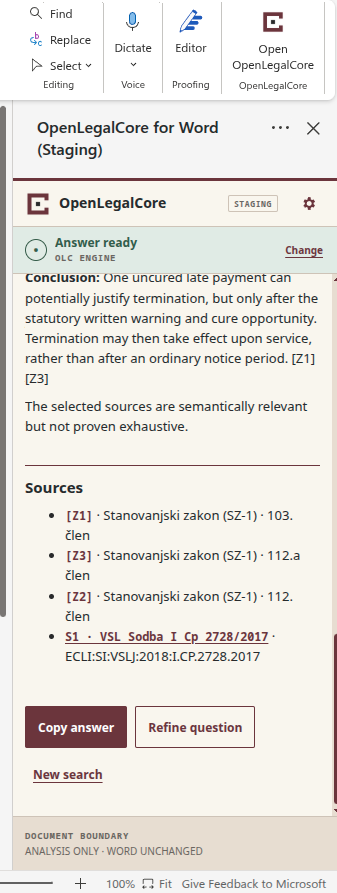
  5. Update / Component / Readiness · CheckingWord Connector public presentation is completeThe Apache-2.0 v0.1.0-beta.1 source-only release now has a complete public component record, homepage feature, Roadmap outcome and discovery path.
  6. Update / Component / Release · CheckingOpenLegalCore Word Connector v0.1.0-beta.1 is publicThe Apache-2.0 source-only beta provides a verified Word for the web path for researching Slovenian legal sources through OLC Engine, directly or through Open WebUI.
  7. Article · CheckingLegal RAG Can Fail Before the Model AnswersA genuine provision can still support the wrong answer. This article shows how collection scope, document splitting, filters and ranking determine which sources a legal AI model ever sees.
  8. Article · CheckingWhen a Correct Citation Leads to the Wrong LawA genuine provision and an official link do not prove that the right law was applied. This article explains why legal AI must preserve temporal versions, transitional rules and the source-selection path.
  9. Update / Project · CheckingPublic project foundation gate is completeOpenLegalCore has completed its public project foundation gate: core public routes, bounded participation channels and publication controls are operating.
  10. Article · CheckingAn Audit Trail Is Not a Log: What a Digital Legal Process Must PreserveAn audit trail is useful when it permits a reasonable reconstruction of the particular process while remaining purpose-bound, appropriately protected and subject to retention rules.
  11. Article · CheckingArticle 86 of the AI Act: Does the right to explanation already apply to Annex III systems?The legal question remains open. The technical capacity to provide an intelligible explanation should not.
  12. Update / Project · CheckingPrivate security reporting is now availableOpenLegalCore now provides a monitored project-wide private channel and a canonical security-reporting policy.
  13. Update / Component / Release · CheckingSlovenian Case Law Pipeline v0.1.7 is publicOpenLegalCore has published the production-verified Slovenian case-law ingestion component as a source-available BUSL-1.1 release.
  14. Article · CheckingA Result Is Not a Method: Why Visible Methods Matter in Legal AIWhy legal AI needs inspectable sources, provenance and human review: a legal and technical analysis of the EU Artificial Intelligence Act and GDPR.
  15. Update / Component / Release · CheckingSlovenian Legislation Pipeline v0.1.0 is publicOpenLegalCore has published the production-verified PISRS legislation-ingest component as a source-available BUSL-1.1 release.
  16. Update / Component / Release · CheckingLegal OCR Pipeline v0.1.2 is publicThe first public OpenLegalCore component is available with code, tests, offline review tooling and a bounded acceptance record.
Explore the code
Menu

Page map

01 / 10

OpenLegalCore / legal-tech infrastructure

Open-source components. A private, reviewable system core.

The law is too important for black-box systems.

Inspect the code. Control the deployment. Verify the method.

OpenLegalCore develops a legal AI engine adapted to the law of each jurisdiction, together with the components around it. It connects GOVERNMENT WEBSITE / GOVERNMENT OFFICE FOR LEGISLATIONPISRS — Legal Information System of the Republic of SloveniaA government website providing access to legislation, case law and other legal information from Slovenia and the EU. It is administered by the Government Office for Legislation. Unofficial consolidated texts make legislation easier to consult, but are not official publications. PISRS also provides access to authentic electronic editions of the Official Gazette of the Republic of Slovenia from 1 March 2026.Open PISRS , OFFICIAL SOURCE / SUPREME COURT OF THE REPUBLIC OF SLOVENIASlovenian case lawSlovenia's authoritative national public case-law collection, published through the judiciary's official service administered by the Supreme Court of the Republic of Slovenia. It is the complete public corpus available through that service; statutory publication rules do not require every decision issued by every Slovenian court to appear.Open the official collection and private documents into controlled, traceable workflows whose operation and results remain open to human verification.

System map / 09 componentsOLC EnginePRIVATE · v0.0.7

Component relationships · not a release sequence

Who OpenLegalCore is for

One architecture.Three ways into the work.

OpenLegalCore components are independently governed building blocks. They can be inspected, challenged and—where status and access allow—combined for a defined legal or administrative process.

01 Developers · technical evaluators · IT teams · students

Inspect the components. Strengthen the contracts.

Read public code and component records, reproduce tests, trace interfaces and contribute implementation, documentation or evaluation work. Private access begins only with a named component and a defined task.

Inspect public repositories

02 Lawyers · notaries · legal researchers · source specialists

Challenge how legal work is represented.

Examine how the system treats authority, applicable dates, evidence, provenance, matter state, analysis, uncertainty and human review. Legal expertise can strengthen the method without becoming a code-only contribution.

Review the legal method

03 Legal teams · public institutions · enterprises · technology partners

Begin with a bounded process.

Define one legal or administrative workflow and the components it may require. Purpose, data, authority, security, review, licensing and publication boundaries are agreed before any integration, evaluation or pilot begins.

Review deployment patterns

Reuse boundary / a reusable component is not a universal solution. Fitness, access and responsibility remain use-specific.

Why open / why this core exists

Legal AI must make its work verifiable.

Open code is only the beginning.Legal infrastructure must preserve an inspectable record from source to use: what entered the system, how it was transformed, which limits apply, what human review covered and who remains responsible.

The standard /

An answer is not enough.

For OpenLegalCore, a legally material result is incomplete unless its sources and transformations can be traced, its method reviewed, its stated limits challenged, its human-review status recorded and responsibility for its use kept explicit. That inspectability is an engineering requirement—not a claim that open software makes the result correct.

The accountability record / five elements

  1. Source

  2. Transformation

  3. System limits

  4. Human review

  5. Responsibility

Across the record / four obligations

Four obligations turn openness into an operating discipline.

  1. Evidence

    Inspect before trust

    Code, methods, source handling and the scope of each claim must remain examinable within their stated access boundaries. Openness does not prove correctness; it makes unsupported claims easier to detect.

  2. Control

    Control the operating boundary

    Institutions must be able to choose their infrastructure, models and deployment boundary instead of making legal documents and system behaviour dependent on one opaque service.

  3. Infrastructure

    Build reusable infrastructure

    Within OLC, OCR, legal-data pipelines, extraction and orchestration must remain separately governed, reusable components that can be inspected, tested, adapted and improved—not rebuilt behind closed interfaces.

  4. Responsibility

    Keep responsibility visible

    Legally material output must remain traceable, reviewable and contestable. A system may support a decision; the person or institution making it remains responsible.

Required outcome /

Every legally material claim must remain connected to its sources, transformations, stated limits, review status and responsible person or institution.

Inspect component records

SYSTEM CORE / ACTIVE DEVELOPMENT

OLC Engine

The cognitive architecture of legal work.

OLC Engine is being built as OpenLegalCore's general-purpose legal cognition core. It brings maintained legal sources, matter context, specialist legal functions and controlled drafting into one inspectable architecture. Slovenia is its first reference jurisdiction, not its product boundary.

Open the engine record

REFERENCE ARCHITECTURE / SIX FUNCTIONAL LAYERS

The diagram shows the full reference architecture, including functions in development and planned functions.
Maintained legal sources → controlled legal work
  1. 01

    Legal sources

    PISRS, Slovenian case law and controlled matter documents.

  2. 02

    Matter context

    Case Memory and task-specific context.

  3. 03

    Legal functions

    Rules, retrieval and specialist calculations.

  4. 04

    Analysis + strategy

    Bounded Analyzer and Strategist functions.

  5. 05

    Controlled drafting

    An optimised Writer with reviewable output.

  6. 06

    Client or process

    Workspace, compatible client or embedded workflow.

Working foundation

Private orchestration core

  • Private orchestration foundation
  • Executable workflow baseline
  • Current implementation boundary recorded

Active development

Context and broader interface layer

  • Case Memory
  • Optimised Writer
  • Broader OpenAI-compatible interface

Planned functions

Specialist legal nodes

  • Deadline calculation
  • Territorial and subject-matter jurisdiction
  • Proactive Analyzer
  • Strategist

Engine deployment / Interface optional

Run the legal engine where legal work already happens.

OLC Engine does not require a web interface. It can run as a standalone service, API or workflow node inside infrastructure controlled by the organisation.

Its source, retrieval, model-provider and review boundaries can be adapted to a bounded legal or administrative process under separately agreed implementation terms.

Propose a defined pilot
  1. 01

    Standalone legal engine

    Run the engine as a service inside an existing internal legal or administrative system. A web interface is optional.

  2. 02

    Standardised compensation workflows

    Use a bounded engine in high-volume claims work in a law firm or insurer, with process-specific rules, documents and review.

  3. 03

    Public-administration workflow

    Embed the engine in a defined public-administration workflow for draft-decision preparation while keeping sources and human responsibility explicit.

  4. 04

    Data + retrieval integration

    Connect existing databases, document stores, PostgreSQL environments, retrieval pipelines and vector infrastructure, including Qdrant.

  5. 05

    Control boundary

    Document access, data movement, model-provider routes, review obligations and operational ownership.

Illustrative boundaryThese are deployment patterns, not customer, partner or production-deployment references.

Engineering boundarySecurity depends on the complete operating environment: access control, updates, secrets, backups, network isolation and the selected model-provider path.

Interface + client boundary

One engine. Optional client surfaces.

One verified reference path is kept separate from the named clients still under evaluation. Tested versions, interface surfaces and claim boundaries are documented in the full record.

View the full compatibility record
  1. 01

    Interface surface

    OpenAI-compatible Chat Completions

    GET /v1/models · POST /v1/chat/completions · Bearer auth · SSE and non-streaming responses.

    PRIVATE · RECORDED SURFACE
  2. 02

    Reference client

    Open WebUI

    The current verified reference client through the direct engine endpoint.

    VERIFIED
  3. 03

    First-party interface

    OLC Legal Workspace

    A planned matter-centred web and desktop workspace for uploaded or permissioned local files, evidence, AI Notes and verifiable sources.

    PLANNED
  4. 04

    Evaluation paths

    LibreChat Jan Onyx LobeChat / LobeHub

    Named-version capability tests remain pending.

    UNDER EVALUATION

Claim boundaryOpen WebUI is the current verified reference client. LibreChat, Jan, Onyx and LobeChat remain named evaluation paths; inclusion does not imply verified compatibility with a tested version.

Component map / Access disclosed

Open when ready. Explicit when not.

The register follows the system from its orchestration core through authoritative legal data, document intake and structured facts to interfaces and connectors. Release order remains a separate roadmap question.

ComponentRoleVersionCurrent statusLicenceCode / artefact
General-purpose legal cognition engine · system core0.0.7PRIVATE · ACTIVE DEVELOPMENTNOT YET DECIDED

Licence boundaryCode, data, documentation and brand rights are decided separately for each component. No project-wide licence should be inferred from this register.

OpenLegalCore

Legal AI / traceability contract

A legal answer needs a chain of custody.

A legally material result is incomplete unless the system can show its authoritative source, applicable version, retrieved passage, model and provider route, stated limits and human-review status. Together, these elements form its chain of custody.

Reference model
Source layer
GOVERNMENT WEBSITE / GOVERNMENT OFFICE FOR LEGISLATIONPISRS — Legal Information System of the Republic of SloveniaA government website providing access to legislation, case law and other legal information from Slovenia and the EU. It is administered by the Government Office for Legislation. Unofficial consolidated texts make legislation easier to consult, but are not official publications. PISRS also provides access to authentic electronic editions of the Official Gazette of the Republic of Slovenia from 1 March 2026.Open PISRS · OFFICIAL SOURCE / SUPREME COURT OF THE REPUBLIC OF SLOVENIASlovenian case lawSlovenia's authoritative national public case-law collection, published through the judiciary's official service administered by the Supreme Court of the Republic of Slovenia. It is the complete public corpus available through that service; statutory publication rules do not require every decision issued by every Slovenian court to appear.Open the official collection · controlled documents
Time boundary
Applicable text at the relevant date
Retrieval
Passages with stable source identifiers
Engine
Jurisdiction-specific legal orchestration
Interface
Legal workspace or compatible client
Responsibility
Human review remains explicit

Required behind every legally material output

  1. 01Jurisdiction + matter boundarynamed
  2. 02Source + applicable versionretained
  3. 03Retrieved passage + identifierinspectable
  4. 04Model + provider routedisclosed
  5. 05Limits + uncertaintyvisible
  6. 06Human-review statusexplicit

Milestones and conditions for further development

Progress is defined by what becomes true.

Below are completed milestones, work in progress and the longer-term direction. The dates refer to releases already published. Further releases depend on each component’s conditions, not on a promised deadline.

View the full roadmap
  1. PHASE 0BASELINE ADOPTED

    Identity and rules

    Identity, release discipline and the public/private boundary are defined. Component licences remain component-specific.

  2. PHASE 1PUBLIC · v0.1.2

    First public OCR release

    The AI-native OCR pipeline, offline review tooling and canonical acceptance record are public under APACHE-2.0.

    RECORDED OUTCOMELegal OCR Pipeline v0.1.2StatusPUBLISHEDAccessPUBLIC SOURCELicenceAPACHE-2.0

    The source repository and canonical acceptance record are public; the source filing and generated acceptance artefacts remain private and outside the package.

  3. PHASE 2FOUNDATION OPERATING

    Public project foundation

    The project home, canonical registers, contribution paths, monitored security channel and publication controls are operating.

  4. PHASE 3EVIDENCE BEFORE EXPANSION

    Community and partnerships

    Open focused RFCs and contribution work, then grow reviewer, maintainer and partner relationships through trust.

  5. PHASE 4ACTIVE · COMPONENT BY COMPONENT

    Selective opening

    Three further public outcomes are recorded: Slovenian Legislation Pipeline v0.1.0, Slovenian Case Law Pipeline v0.1.7 and OpenLegalCore Word Connector v0.1.0-beta.1. Together with Legal OCR Pipeline, OpenLegalCore now has four public components. Selective opening continues component by component; every private or gated component retains its own release gate.

    RECORDED OUTCOMESlovenian Legislation Pipeline v0.1.0StatusPUBLISHEDAccessPUBLIC SOURCELicenceBUSL-1.1

    The source repository is public; PISRS credentials, legislative text and legislation data snapshots remain outside the package and behind separate access and release boundaries.

    RECORDED OUTCOMESlovenian Case Law Pipeline v0.1.7StatusPUBLISHEDAccessPUBLIC SOURCELicenceBUSL-1.1

    The source repository is public; case-law records and data snapshots remain behind their separate release gate.

    RECORDED OUTCOMEOpenLegalCore Word Connector v0.1.0-beta.1StatusPUBLISHEDAccessPUBLIC SOURCELicenceAPACHE-2.0

    The Apache-2.0 source-only beta, documentation, tests and Word-for-the-web evidence are public. It includes no hosted OpenLegalCore service, production backend, legal database, protected staging access or Office Store distribution; Word for Windows and Word for Mac remain untested.

  6. PHASE 5LONGER-TERM DIRECTION

    Sustainable ecosystem

    Build stable releases, active maintainership, verified uses and sustainable support for shared infrastructure.

Governance / Operating truth

Open code does not meanhidden responsibility.

OpenLegalCore begins with founder-led governance. Public discussion is welcome; product direction, access, releases and the project identity retain clear accountability.

01

Public foundation

Useful on its own.

Working software, documentation, tests, synthetic examples, evaluation tools and review methods are released only after the relevant readiness gate.

No deliberately crippled teaser repositories
02

Private incubation

Protected while incomplete.

Unfinished components, sensitive integrations and production evidence remain private until rights, limits and release conditions are resolved.

No promised opening date
01 / MODEL

Founder-led

Maintainer rights are earned through sustained judgement and trusted work.

02 / LICENCE

Component decisions

Code, data, documentation and brand rights are handled separately. Public component licences are named individually; unreleased component licences remain undecided.

03 / PRIVACY

Synthetic public data

Private legal documents, evidence packages and credentials stay outside public repositories.

04 / SECURITY

Private reporting path

Suspected vulnerabilities now have a monitored project-wide private channel. Public issue trackers must not be used for security reports.

Report privately

Funding does not buy governance, maintainer status or automatic access to private source code.

Articles / Long-form reading

Methods, architecture and arguments.

Long-form work on verifiable legal AI, public methods, system design and the limits of automation.

View all articles

OPENLEGALCORE / CORE ARGUMENT

Legal AI infrastructure

Who Controls the Legal AI Stack?

Public code can enable inspection without proving control of the whole system. Follow versions, provenance, data sovereignty, exit and regulatory roles in legal AI.

Author
Rajko Majcen
Reading time
37 min
Research verified
23 September 2026
Read core argument

LATEST PUBLICATIONS

  1. 01

    Law-firm data security

    A Server in the Office Is Not a Security Strategy

  2. 02

From public record to shared work

Build the legal infrastructurethat should exist.

Public components are open to inspect. Private components are shared only within defined contributions, evaluations, integrations or pilots—with purpose, scope and access agreed first.

Access follows the work. Start with your role.

01 / Contribute to the work

Bring the expertise the work needs.

Name the component, the problem and what you can contribute. Code, tests, documentation, legal-method review and source expertise are all valid starting points. Public repositories remain open for direct work.

Public repositories

02 / Build a defined outcome

Bring a real problem. Build the right version.

Legal teams, public institutions and technology partners can propose a pilot, integration, evaluation or scoped adaptation. If the work requires private access, its purpose and scope—and the licensing and publication boundaries—are agreed first.

Access boundaryPrivate access is scoped to agreed work. It does not create ownership, maintainer status or decision rights.

A concrete problem is enough to begin.

Project accountability

Responsibility has a name.

Open participation broadens the work without blurring who is accountable for project direction, releases and public–private boundaries.

Rajko Majcen, founder and maintainer of OpenLegalCore.

FOUNDER · MAINTAINER

Rajko Majcen

Rajko Majcen is a technology founder, technical project leader and product builder with more than three decades of work across security engineering, electronic banking, telecommunications, enterprise systems, open-source infrastructure and applied AI. He founded OpenLegalCore to bring that systems experience to transparent, verifiable legal technology.